
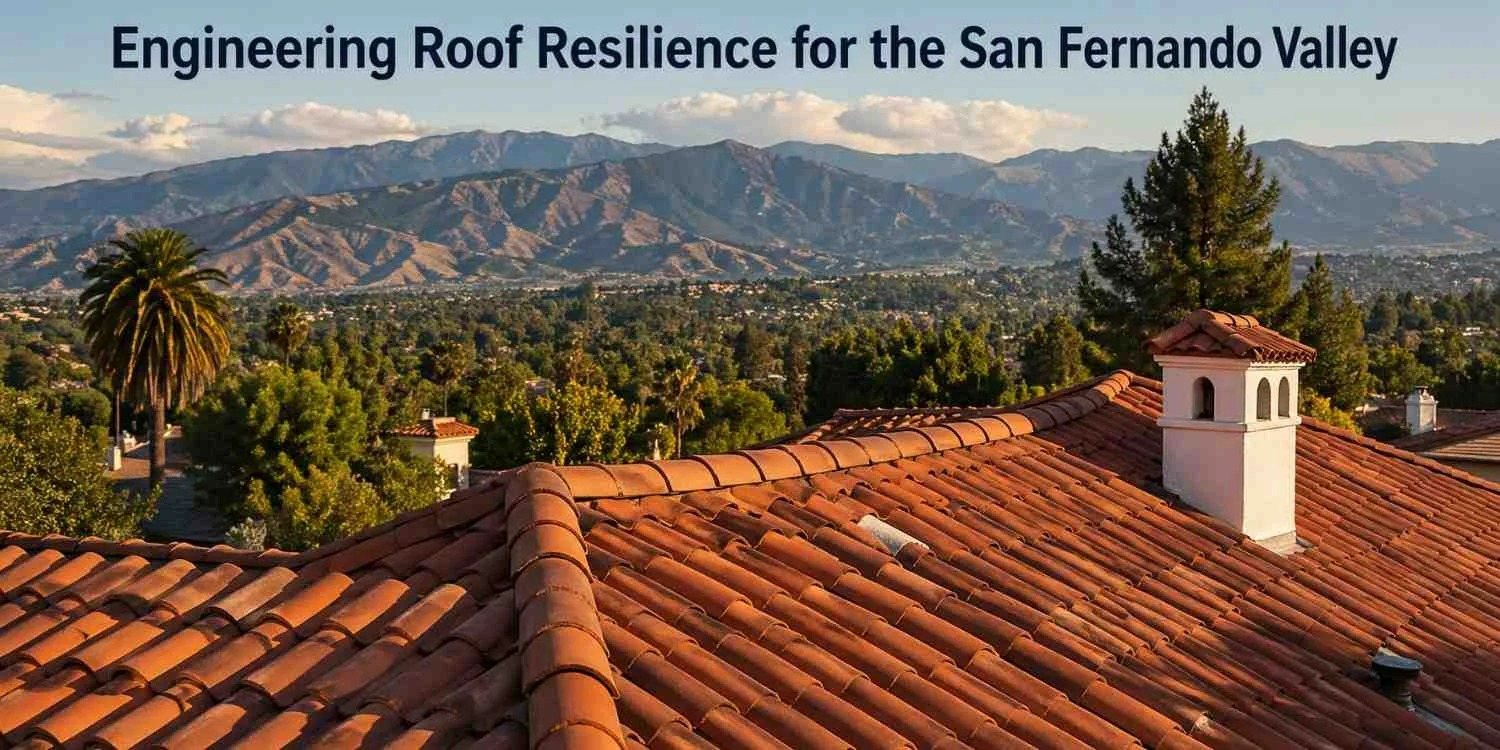
In the architectural landscape of Southern California, the roof is often viewed through the lens of aesthetic harmony, the classic terracotta curves of a Spanish Colonial or the sleek, dark lines of a Mid-Century Modern. However, beyond the visual contribution to curb appeal lies a complex engineering challenge. In the San Fernando Valley, a residential roof must function as a high-performance thermal regulator, a structural stabilizer, and a primary defense against an environment that is increasingly defined by extremes. Understanding how these systems interact is essential for any homeowner looking to protect their property investment over the long term.
The Thermal Challenge of the Basin and Valley
While many regions of the country prioritize protection against snow loads and ice dams, the primary adversary in Los Angeles is the sun. Ultraviolet (UV) radiation and infrared heat work in a relentless cycle to degrade building materials. On a typical summer afternoon in the Valley, rooftop temperatures can soar well above 150°F. This heat doesn’t just sit on the surface; it attempts to migrate into the structure, placing an immense burden on the home’s building envelope.
The key to longevity in this climate is the management of “thermal movement.” Every material on a roof, from the wooden decking to the metal flashing and the primary shingles or tiles, expands and contracts at different rates as temperatures fluctuate. Over several seasons, this constant physical shifting can lead to “material fatigue.” In asphalt systems, this manifests as the loss of protective granules; in tile systems, it can result in the shifting of individual pieces, exposing the vulnerable underlayment beneath. A high-performance roof is designed to breathe and move without compromising its waterproof seal, a feat that requires precise installation and high-grade material selection.
Beyond the Shingle: The Importance of Attic Thermodynamics
A common misconception in the roofing industry is that the outer layer is the only thing that matters. In reality, a roof is a multi-layered system where the underside is just as important as the topside. Proper attic ventilation is the “secret sauce” of a long-lasting roof. Without a balanced airflow system, the attic becomes a heat reservoir, “cooking” the shingles from below and causing them to age prematurely.
The objective is to achieve a temperature equilibrium. By utilizing intake vents at the eaves and exhaust vents at the ridge, a natural convection current is created. This airflow flushes out hot, stagnant air and reduces the temperature of the roof deck. For homeowners, this translates to lower cooling costs and a significantly extended lifespan for the roofing materials. When these systems are ignored, even the most expensive materials will fail years before their intended expiration date. This technical nuance is why local expertise is so vital; understanding the specific wind patterns and heat indices of the region allows for a ventilation strategy tailored to the home’s micro-climate. For those seeking a deeper dive into these technical specifications,Overhead Roofing LA provides a comprehensive look at how modern systems are integrated to combat these local stressors.
Material Science in a High-Risk Environment
The selection of roofing materials in Southern California is increasingly dictated by fire safety and energy efficiency. With the expansion of the wildland-urban interface, fire resistance has moved from a luxury to a necessity.
- Synthetic Composites: Modern technology has birthed materials that mimic the appearance of natural slate or wood shake but carry a Class A fire rating. These synthetics are engineered with advanced UV inhibitors, ensuring they remain flexible and color-fast despite decades of sun exposure.
- Stone-Coated Steel: This material offers the structural durability of metal with the traditional aesthetic of Mediterranean tile. It is particularly advantageous in seismic zones because it is significantly lighter than traditional clay or concrete. Reducing the “dead load” at the highest point of a house can improve the structure’s performance during an earthquake.
- Cool Roof Technology: Many modern shingles and tiles are now embedded with reflective granules designed to bounce solar energy back into the atmosphere. By reducing the “solar heat gain” of a building, these materials help mitigate the urban heat island effect, keeping entire neighborhoods cooler during heatwaves.
The Vulnerability of Transitions: Flashing and Penetrations
If you were to map out where the majority of roof leaks occur, they are rarely found in the middle of a flat expanse of shingles. Instead, they occur at the “interruptions”, the chimneys, skylights, plumbing vents, and valleys where different planes of the roof meet. These areas are protected by flashing, typically made of galvanized steel or copper.
The engineering of these transitions is where the true skill of a craftsman is revealed. In many older homes, flashing was “sealed” with petroleum-based mastics that eventually dried out and cracked. A superior approach involves mechanical flashing, where metal is custom-bent and integrated into the siding or masonry. This creates a permanent, gravity-led barrier that does not rely on adhesives. In a region that experiences long dry spells followed by intense “atmospheric river” rain events, these metal-to-metal transitions are the only thing preventing wind-driven rain from entering the wall cavities and causing hidden rot.
The Economic Impact of Proactive Maintenance
In a high-value real estate market like Los Angeles, a roof is a significant portion of a property’s “deferred maintenance” profile. A roof that is nearing the end of its life can be a major hurdle during a real estate transaction, often leading to heavy credits or price reductions. Conversely, a well-documented history of maintenance and a modern, high-efficiency roof can be a powerful selling point.
A proactive maintenance schedule, ideally a bi-annual check, allows for the clearing of debris from valleys and the inspection of sealants around penetrations. In the Valley, wind-blown debris from oak and eucalyptus trees can act as a sponge, holding moisture against the roof and causing “back-pitching,” where water travels upward under the shingles. Addressing these minor issues for a few hundred dollars can prevent a five-figure structural repair down the road.
A Legacy of Protection
A roof is more than just a cover; it is a sophisticated shield that manages the complex relationship between a home’s interior and the external environment. By prioritizing thermal management, fire-rated materials, and mechanical flashing, homeowners can ensure that their sanctuary remains secure regardless of the season. In the end, the goal is resilience, creating a structure that can withstand the test of time, heat, and wind while providing a safe and efficient environment for those within. When the science of the building envelope is respected, the roof becomes a silent, enduring guardian of the home’s legacy.
